
Connect
Wires an output port of one module instance to an input port of another, through their nearest common parent.
- Neovim:
:Connect <source_module> <dest_module> - VS Code:
LazyVerilog: Connect
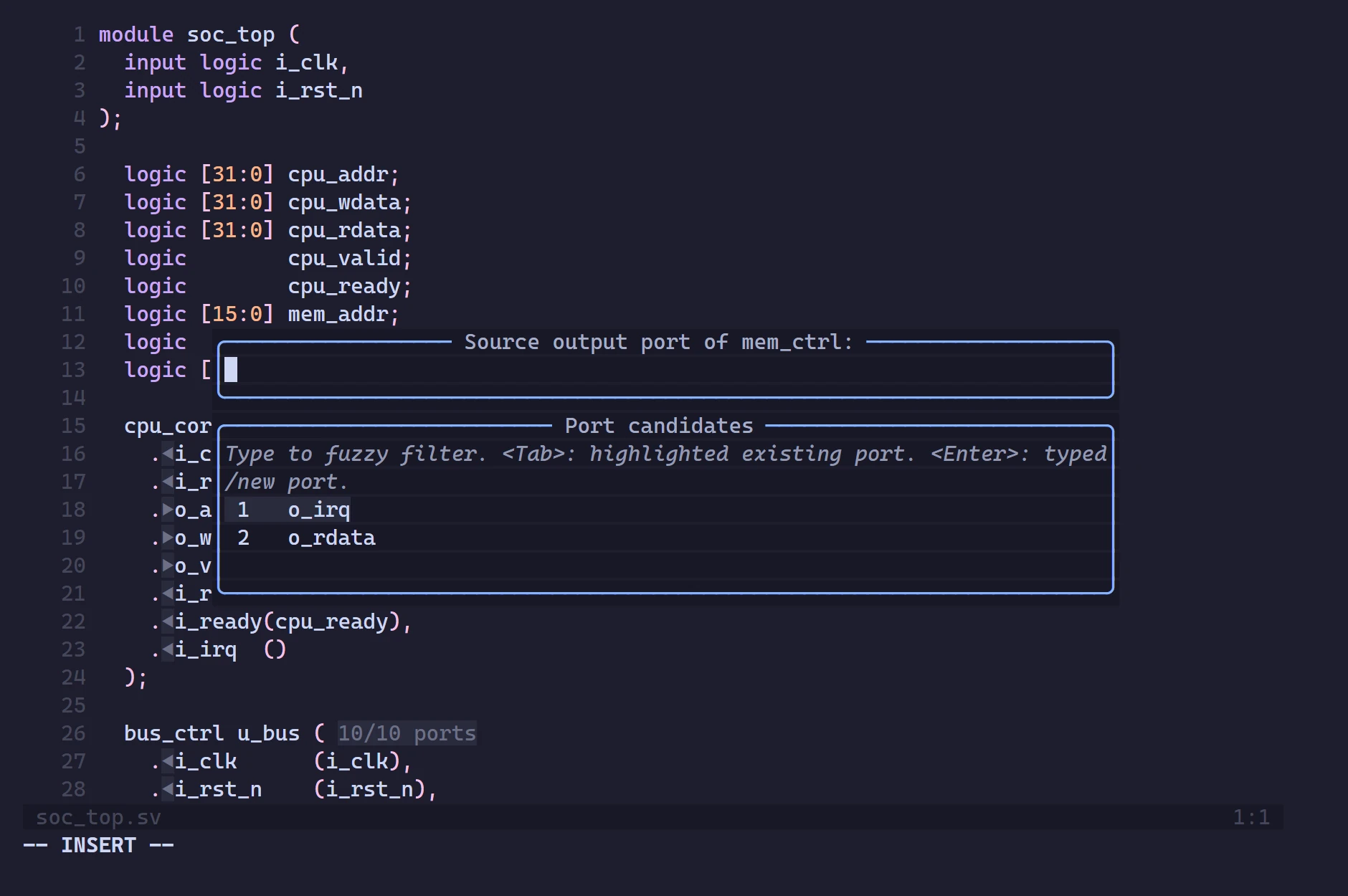
You are asked to pick:
- an instance of the source module, and its output port
- an instance of the destination module, and its input port
- a name for the wire
A preview shows the edits before anything is applied.
![Neovim showing the Connect Preview: two port connections and a new wire declaration, with [y] Apply and [n] Cancel](/screenshots/connect-preview-neovim.webp)
What it edits
- Sets
.port(signal)on both instances, replacing an existing connection (the preview warns). - Declares the wire in the common parent if it is not declared yet.
- For instances in different branches of the hierarchy, adds pass-through ports on the modules between.
- On a type mismatch it warns and continues, using the source port's type.
Wire type
The wire copies the source port's type. Net-style outputs become logic, and user-defined types and symbolic dimensions are kept as written:
systemverilog
output wire [5:0] o_data              // becomes: logic [5:0] data32;
output payload_t [`BUS_W-1:0] payload // becomes: payload_t [`BUS_W-1:0] payload_w;
If neither port exists yet, the wire is logic.
Limits
Connect works on syntax, not elaboration, so it does not handle complex generate hierarchy, macro-generated instances, positional connections, or SystemVerilog interface/modport ports. Check the preview when the code is unusual.