
Interface
A view of the signals shared between instances, where you can also connect and disconnect them.
- Neovim:
:Interface <inst>or:Interface <inst1> <inst2> - VS Code:
LazyVerilog: Interface
One instance
Read-only. Lists each port, the signal it is connected to, and the sibling ports on the same signal.
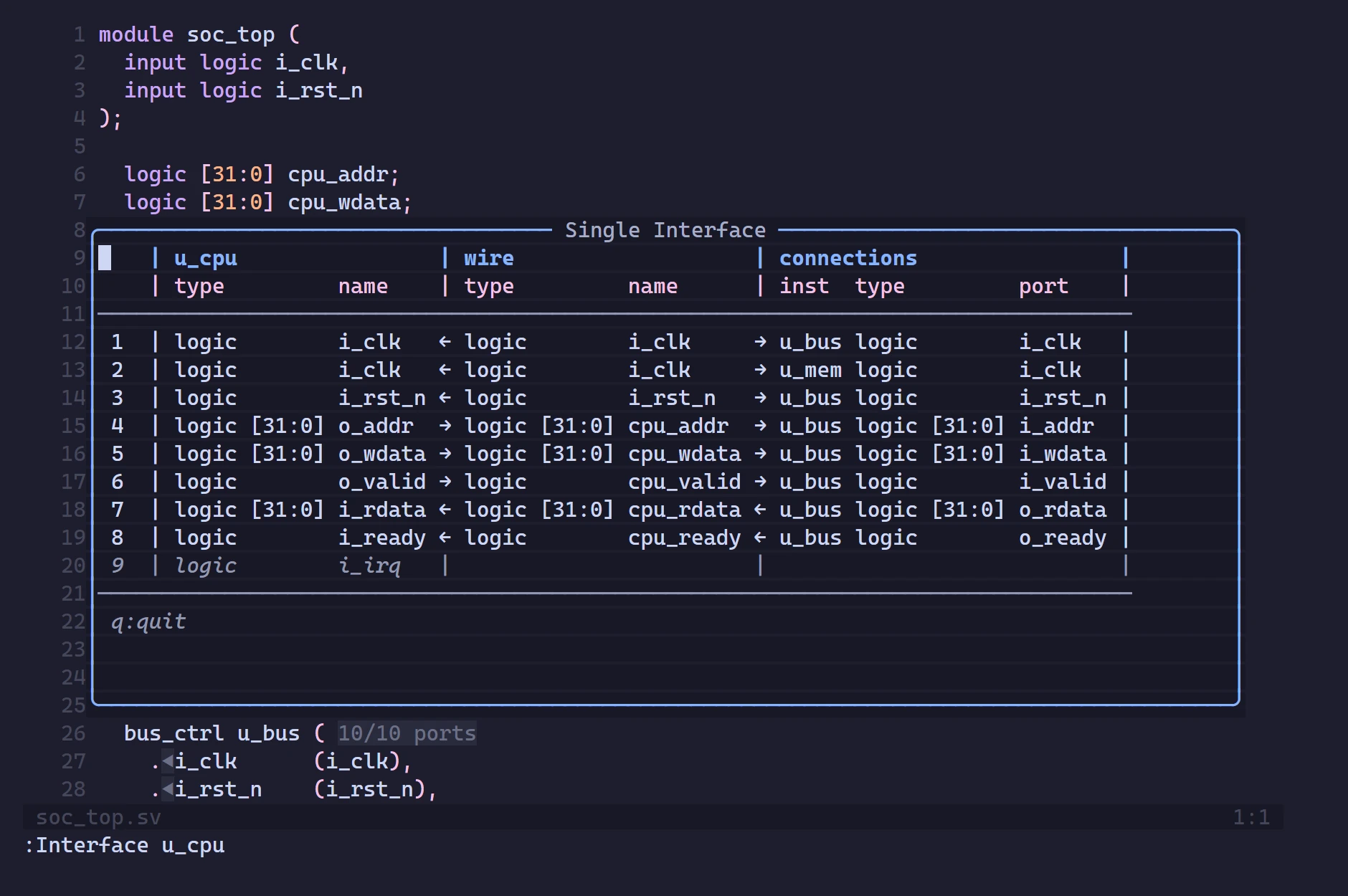
Two instances
![Neovim's Interface window for u_cpu and u_bus: a table of ports and shared signals, with [C]onnect and [D]isconnect](/screenshots/interface-neovim.webp)
A table with the ports of the first instance, the shared signal, and the ports of the second. Ports with the same signal name share a row. A port with no partner gets its own row. Arrows show direction: → output, ← input, ↔ inout, | no match.
In Neovim's floating window, C connects, D disconnects, and q closes.
Connect
Press C, then choose the row of the first port, the row of the second, and a wire name. The edit sets .port(signal) on both instances and declares the wire if needed. The wire type follows the output port, as in Connect.
Disconnect
Press D and choose a row. The edit clears .port(signal) on both instances when they still match the row, and deletes the signal's declaration if it is a simple wire, logic, or reg.
logic [5:0] data32;
memory u_mem2 (.o_data(data32));
memory u_mem3 (.i_data(data32));
becomes
memory u_mem2 (.o_data());
memory u_mem3 (.i_data());
A declaration with several names, an assignment, or another keyword is left for you to remove.
Limits
Interface works on syntax, not elaboration. It expects ordinary instances with named connections, and does not handle SystemVerilog interface or modport, complex generate hierarchy, macro-generated instances, or positional connections.